
Chat Face

Chat Zalo

Phone

Office equipment, IT, telecom devices.
Technology development equipment
Industrial automation equipment
Components and accessories for electric vehicles
Measuring instruments
Home Appliances
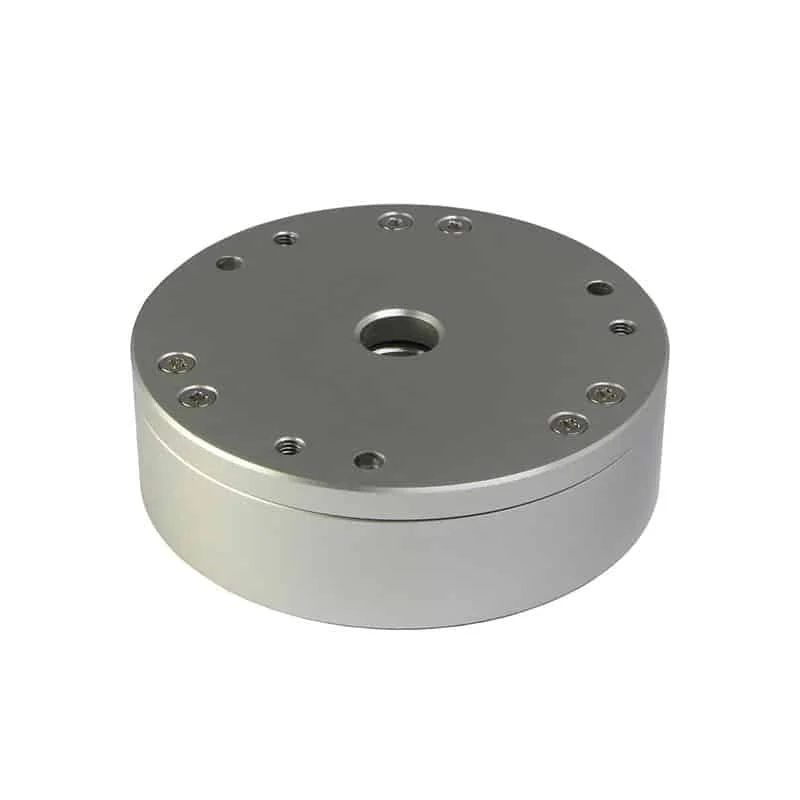


Ultra-compact and ultra-lightweight design, ideal for light-payload robots requiring precise force sensing.
Simultaneous measurement of linear force (Force) and rotational torque (Torque) in a single sensor.
Rated capacity of 200 N | 4.5 Nm, suitable for light to medium manipulation applications.
High resolution enables smooth signal acquisition and fast response in control systems.
Supports 150% full-scale overload, providing sufficient safety for standard industrial environments.
Weighs only 70 g, significantly lighter than conventional force–torque sensors.
Easy connection to data acquisition systems or robot controllers (PLC, PC).
Widely used in collaborative robots, screw torque testing, machine learning, and tactile simulation.
 Free shipping radius TOÀN QUỐC
Contact support for detailed quote: Hotline: 0386365636
Buy at Vina Connect Showroom See directions
Integrated force and torque sensor with an extremely compact design, only 18.5 mm thick, optimized for service robots and low-payload collaborative robots.
Rated capacity of 200 N (force) and 4.5 Nm (torque), well suited for delicate manipulation and automated assembly tasks.
High resolution of 0.15 N for force and 0.005 Nm for torque, enabling accurate detection of subtle force variations.
Supports 150% full-scale overload, protecting the sensor against unexpected loads or misaligned force application.
Ultra-lightweight at only 70 g, minimizing payload impact on robot end-effectors or grippers with limited load capacity.
Flat, circular structure with an optimized mounting surface, easy to fix onto flat plates or integrate into automation modules.
Wide range of applications including collaborative robots, screw torque inspection, bottle cap tightening, tactile simulation, digital healthcare, AI training, and force-feedback research.
Manufactured by ROBOTOUS, a specialist in force and torque sensors for precision robotics and automation.
Please visit our comparative table for a complete listing of features and specifications.
Note: If you desire an EtherCAT interface for this sensor, purchase the CAN version of the sensor and also buy the Robotous RFTEC-02 EtherCAT Adapter.
| Category | Specification |
|---|---|
| Model | RFT60-HA01 |
| Sensor type | Combined force & torque sensor |
| Rated capacity | 200 N (force), 4.5 Nm (torque) |
| Resolution | 0.15 N (force), 0.005 Nm (torque) |
| Overload capacity | 150% of Full Scale |
| Dimensions | Ø60 mm × 18.5 mm (H) |
| Weight | 70 g |
| Output interface | Analog / Digital (order-dependent) |
| Housing material | Lightweight alloy or high-grade aluminum |
| Operating temperature | −10 °C to +60 °C |
| Applications | Collaborative robots, low torque measurement, force simulation |
| Warranty | 12 months (official) |
| Brand | ROBOTOUS – South Korea |
Position the sensor on a mounting plate, robot end-effector, or automation module using the threaded holes on the bottom surface.
Ensure the sensing surface is not twisted, bent, or unevenly compressed during installation.
Align the primary sensor axis with the direction of applied force
(Z-axis or X-axis depending on the application).
Connect the sensor to a data acquisition system, computer, or robot controller using the dedicated signal cable.
Perform zero-load calibration before operation to ensure accurate measurements.
Configure monitoring or communication software to receive real-time sensor data.
The sensor continuously outputs force and torque feedback, enabling monitoring of twisting, pushing, pulling, and contact operations.
Force and torque values can be transmitted to a host system for control, machine learning, or graphical visualization.
Avoid exceeding 150% of full scale to maintain sensor longevity.
After use, clean the sensor with a soft, dry cloth; avoid water or prolonged dust exposure.
Store in a dry environment with stable temperature, avoiding mechanical shock or shaft damage.
Periodically inspect signal cables to prevent looseness, breakage, or signal noise.
We will contact and send a quote based on the information you provide!






.webp)