
Chat Face

Chat Zalo

Phone

Office equipment, IT, telecom devices.
Technology development equipment
Industrial automation equipment
Components and accessories for electric vehicles
Measuring instruments
Home Appliances


Industrial-grade USB to CAN/CAN FD converter with two fully isolated independent channels
Supports CAN2.0A, CAN2.0B, and ISO11898-1 CAN FD protocol standards
Up to 3000V DC isolation between USB interface and CAN channels, ensuring safe operation in high-noise environments
Flexible baud rate range from 100 kbps to 5 Mbps with stable data transmission
High processing performance, supporting up to 20,000 received frames and 5,000 transmitted frames per second
Flame-retardant aluminum alloy enclosure, stable operation from −40 °C to +85 °C
Broad OS compatibility: Windows, Linux, Android, Raspberry Pi, easy to deploy and use
 Free shipping radius TOÀN QUỐC
Contact support for detailed quote: Hotline: 0386365636
Buy at Vina Connect Showroom See directions
Industrial Grade CAN/CAN FD Bus Data Analyzer, USB To CAN FD Adapter, CAN/CAN FD Bus Communication Interface Card, CAN/CAN FD Protocol Data Analyzer
Industrial Grade CAN/CAN FD Bus Adapter
Supports high-speed CAN FD and CAN2.0A/B data communication
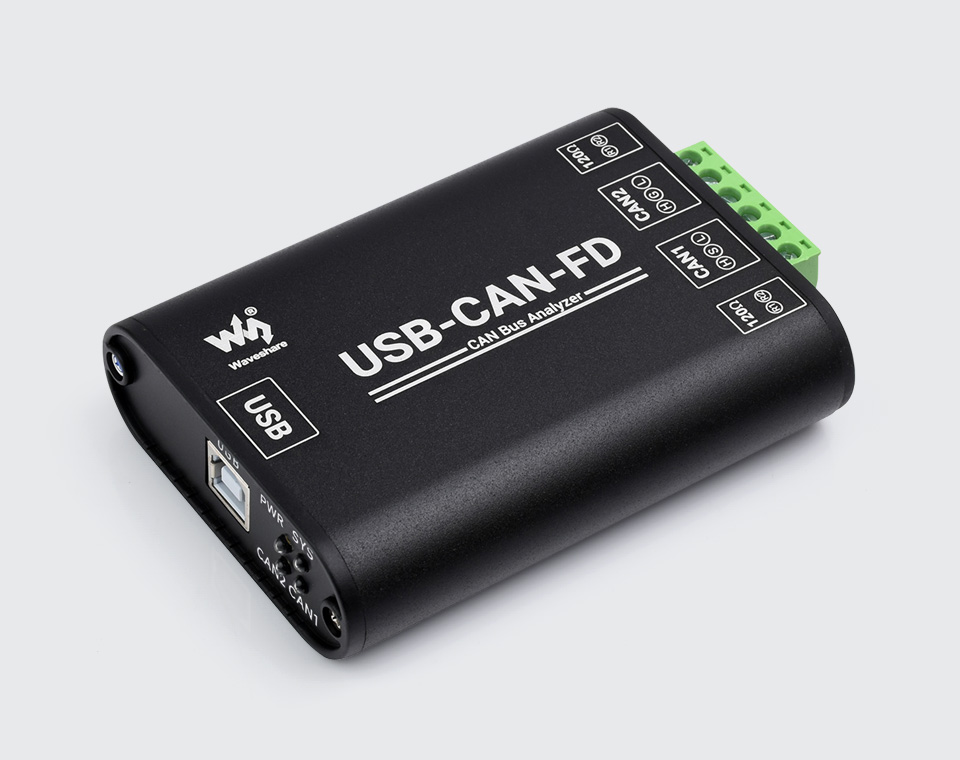
Version Options
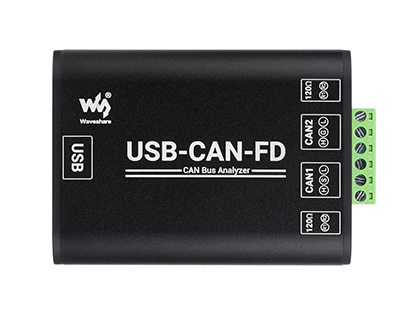
USB-CAN-FD
Supports Windows system
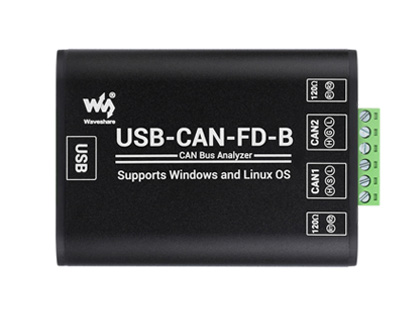
USB-CAN-FD-B
Supports Windows and Linux systems
The USB-CAN-FD only supports Windows XP/7/8/10/11 and does not support Linux systems.
The USB-CAN-FD-B is an upgraded version of the USB-CAN-FD with Linux systems support, including Raspberry Pi OS (for Raspberry Pi), Ubuntu (for Jetson Nano), and Linux system on VMware virtual machines, etc.
Features at a glance
This product is an industrial-grade high-performance USB to CAN FD adapter, CAN/CAN-FD bus communication interface card, and CAN/CAN-FD protocol data analyzer. Onboard dual independent CAN FD interfaces with electrical isolation and multiple protection circuits. Comes with drivers, CAN FD Tools related software, secondary development examples, and tutorials.
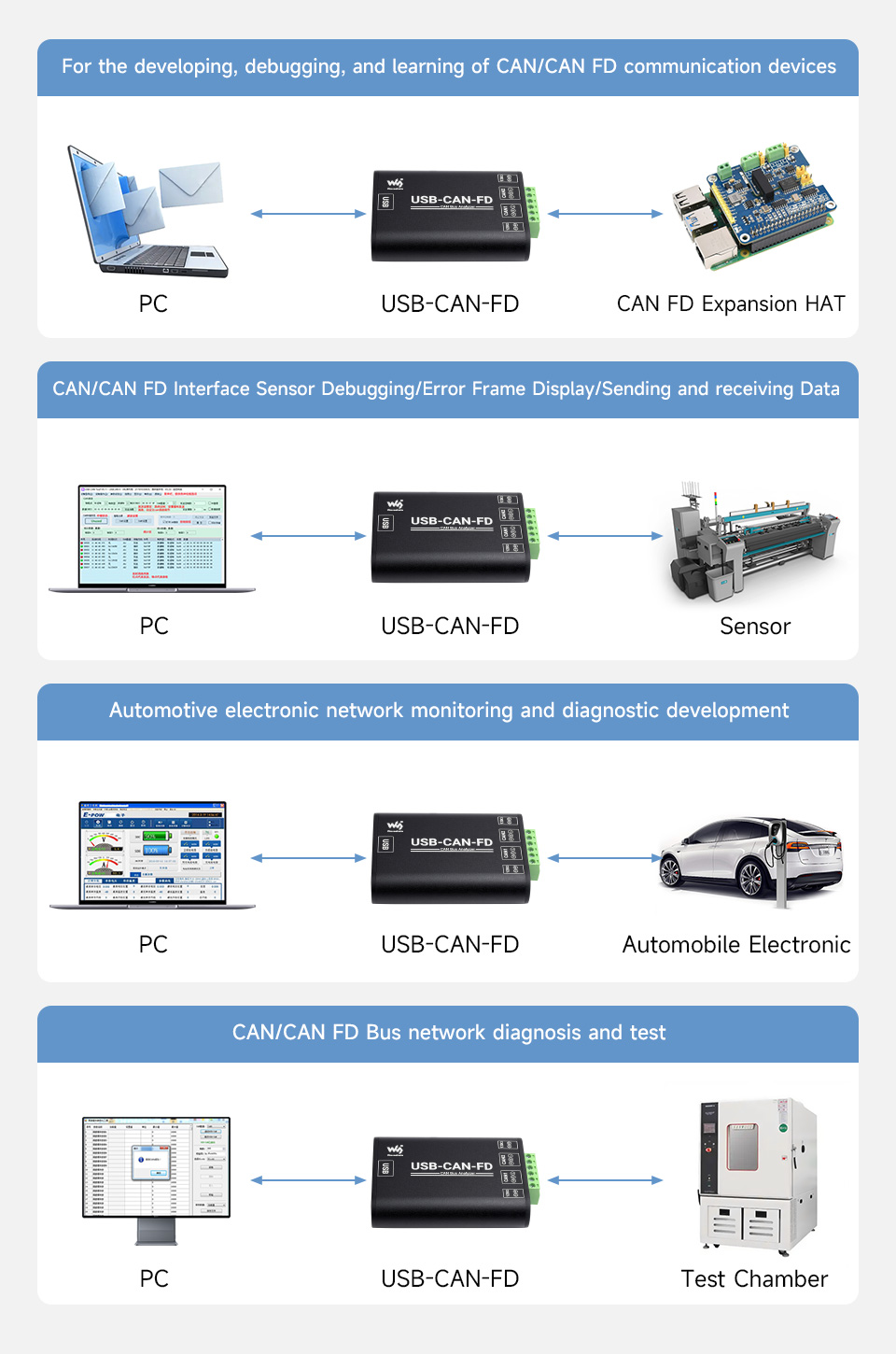
It can be connected to the PC or industrial control host via a USB port to realize transceiver control, data analysis, collection and monitoring of CAN/CAN FD bus network. It is compact in size and easy to use, which can be used for learning and debugging of CAN/CAN FD bus, as well as for secondary development and integration into various industrial, power communication, and intelligent control applications that require CAN/CAN FD bus communication.
Specifications
| Product | Model | USB-CAN-FD | USB-CAN-FD-B |
|---|---|---|---|
| Picture |
|
|
|
| Type | Industrial grade: USB to CAN FD interface converter, CAN/CAN FD bus communication interface card, CAN/CAN FD protocol data analyzer | ||
| USB | Operating voltage | 5V (directly powered by USB port without external power supply) | |
| Connector | USB-B | ||
| CAN/CAN FD interface | CAN/CAN FD channel | Dual-channel: CAN1 and CAN2 (independent and full-isolated, isolated voltage: 3000V DC) | |
| Connector | CAN bus screw terminal (OPEN6 5.08mm pitch) | ||
| Terminal resistor | Each CAN/CAN FD channel has two built-in 120Ω terminal resistors, which can be enabled by switch | ||
| Baud Rate | 100Kbps~5Mbps (Configurable via software) | ||
| Protocol Support | CAN2.0A, CAN2.0B, and ISO 11898-1 CAN FD protocol V.1.0 | ||
| Transfer speed | The receiving and sending speed of each CAN/CAN FD channel can reach 20000 frames/s and 5000 frames/s | ||
| Transmit buffer | 1500 frames receiving buffer and 64 frames sending buffer per channel (automatically retransmit when the transmission fails) | ||
| Indicators | PWR | Power indicator | |
| SYS | System status indicator, normally off; keeps on when there is a bus error | ||
| CAN1 | CAN1 channel indicator (blinking when sending and receiving data) | ||
| CAN2 | CAN2 channel indicator (blinking when sending and receiving data) | ||
| System support | Windows | Windows XP/7/8/10/11 (32/64 bits) | |
| Linux | Not support | Raspberry Pi OS (for Raspberry Pi), Ubuntu (for Jetson Nano), Linux system on VMware virtual machines, etc. |
|
| Operating temperature | -40~85℃ | ||
| Case material | Aluminum alloy case + 3D flame-retardant insulating sheets on both sides (This design can provide better protection against metal tip discharge, also improves product safety, and extends service life) | ||
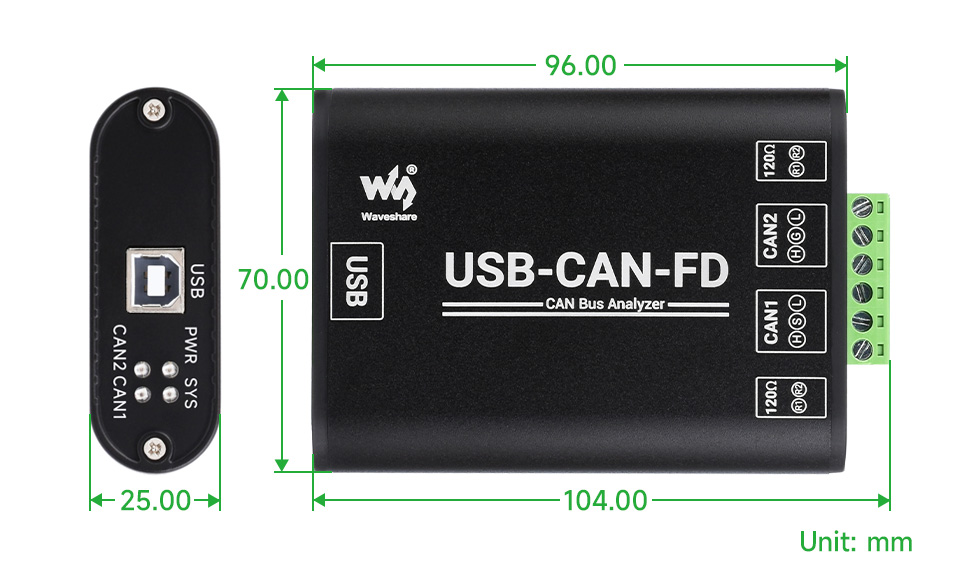
| Dimensions | 104 × 70 × 25 mm | ||
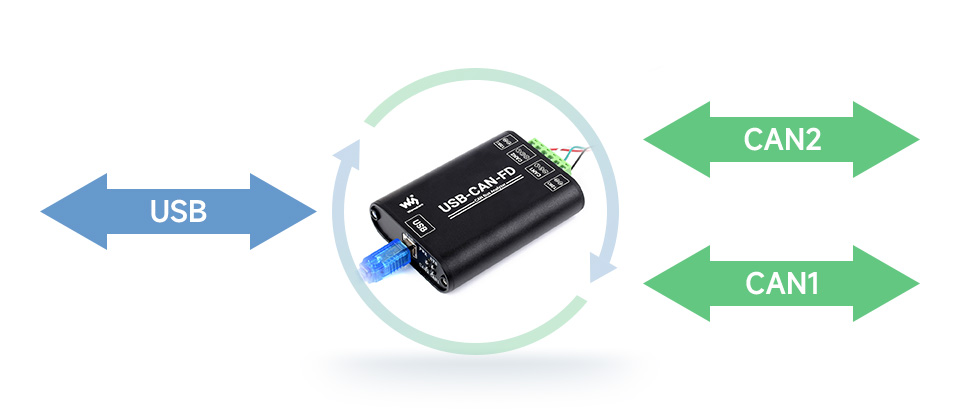
Supports Protocol Conversion
Between USB And CAN/CAN FD Bus
Onboard high-speed USB2.0 interface and 2-ch CAN/CAN FD Bus Interfaces, support bi-directional transmission, can work independently without interfering with each other
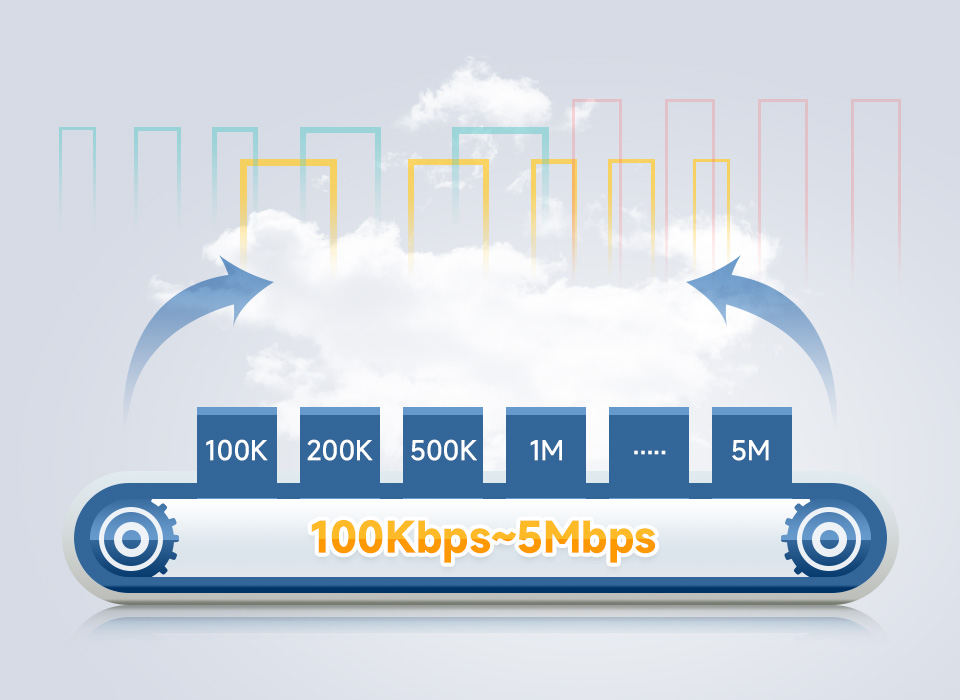
Programmable Baud Rate, Automatic Detection
CAN baud rate is configurable in the range of 100Kbps~5Mbps
Supports baud rate calculation, auto-detection, and setting via the configuration tool
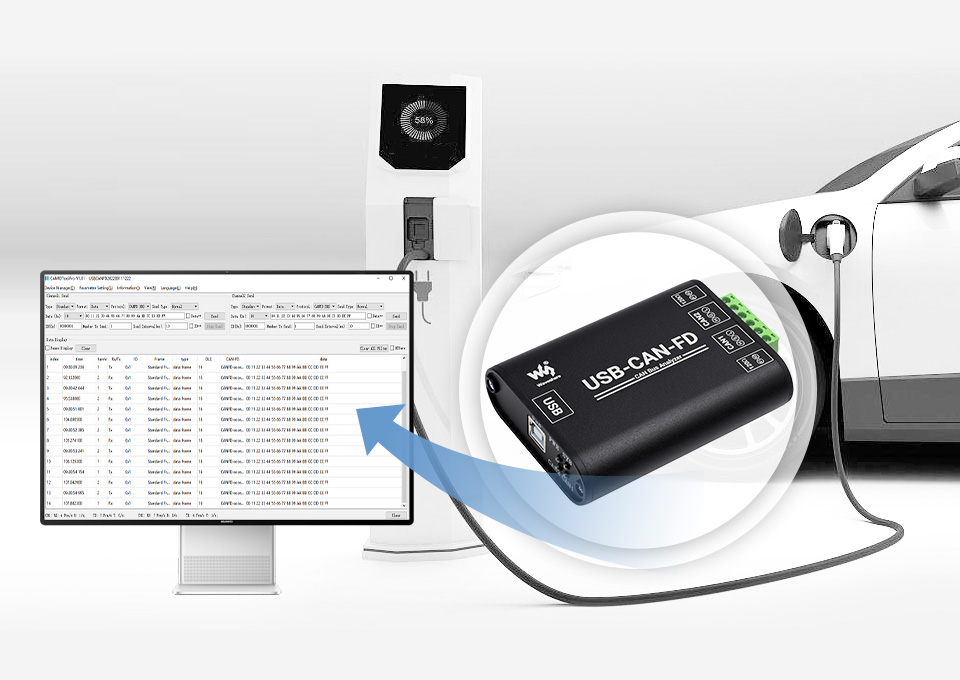
Supports Decoding and Analyzing for
multiple CAN Protocols
Supports CAN 2.0A, CAN 2.0B, ISO11898-1, and CAN FD Protocol Specification V.1.0, Supports Standard and Extended Frames
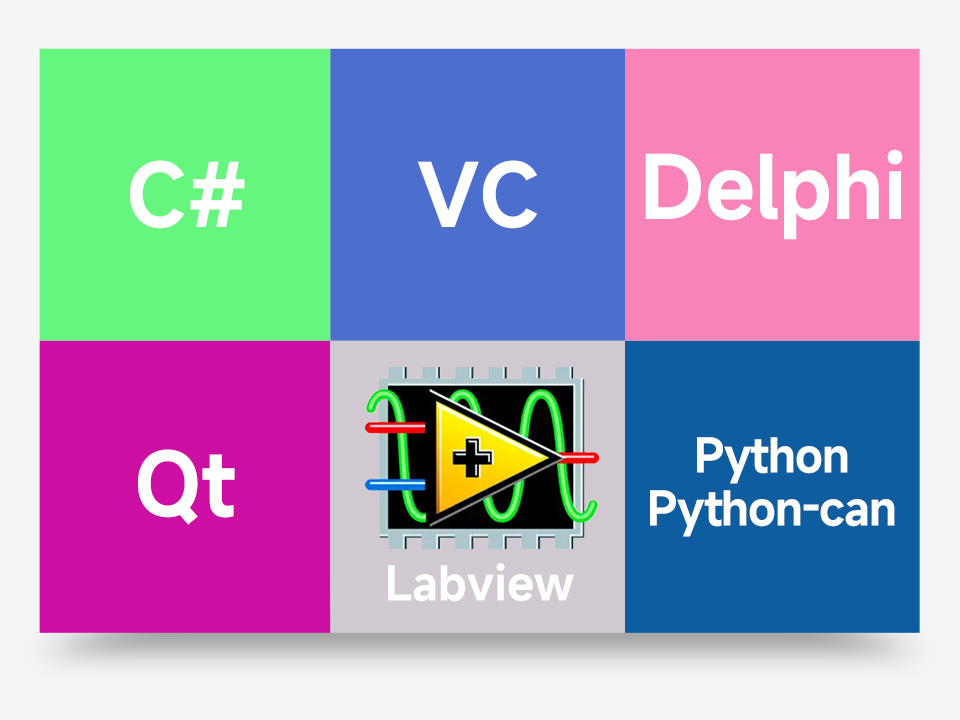
Supports Multi Development Environments
Provides examples for secondary development projects on various mainstream development platforms: C#, VC, Delphi, Qt, LabVIEW, Python/Python-can
High-performance Hardware Solution
Adopts original controller and 32-bit MIPS M4K Core, up to 80MHz frequency, with high performance, stable and reliable

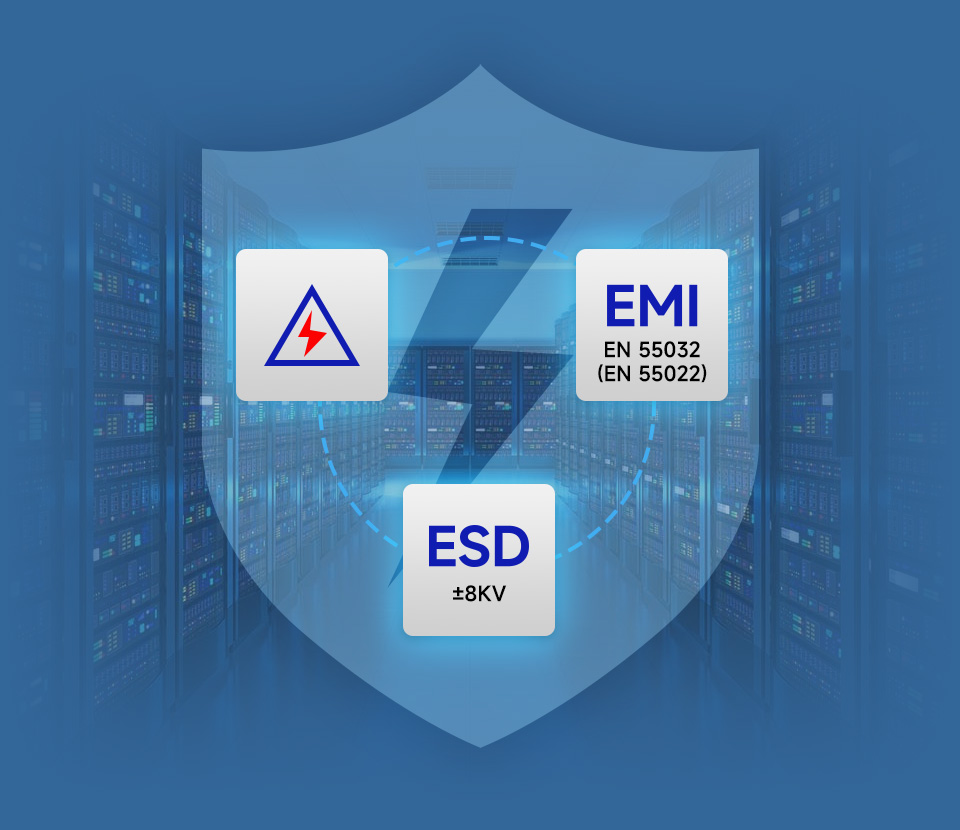
with electrical isolation and multiple
protection circuits
Adopts high-speed signal isolators, DC-DC dual power isolation, USB, CAN1 and CAN2 three-terminal full isolation, higher communication security and stability
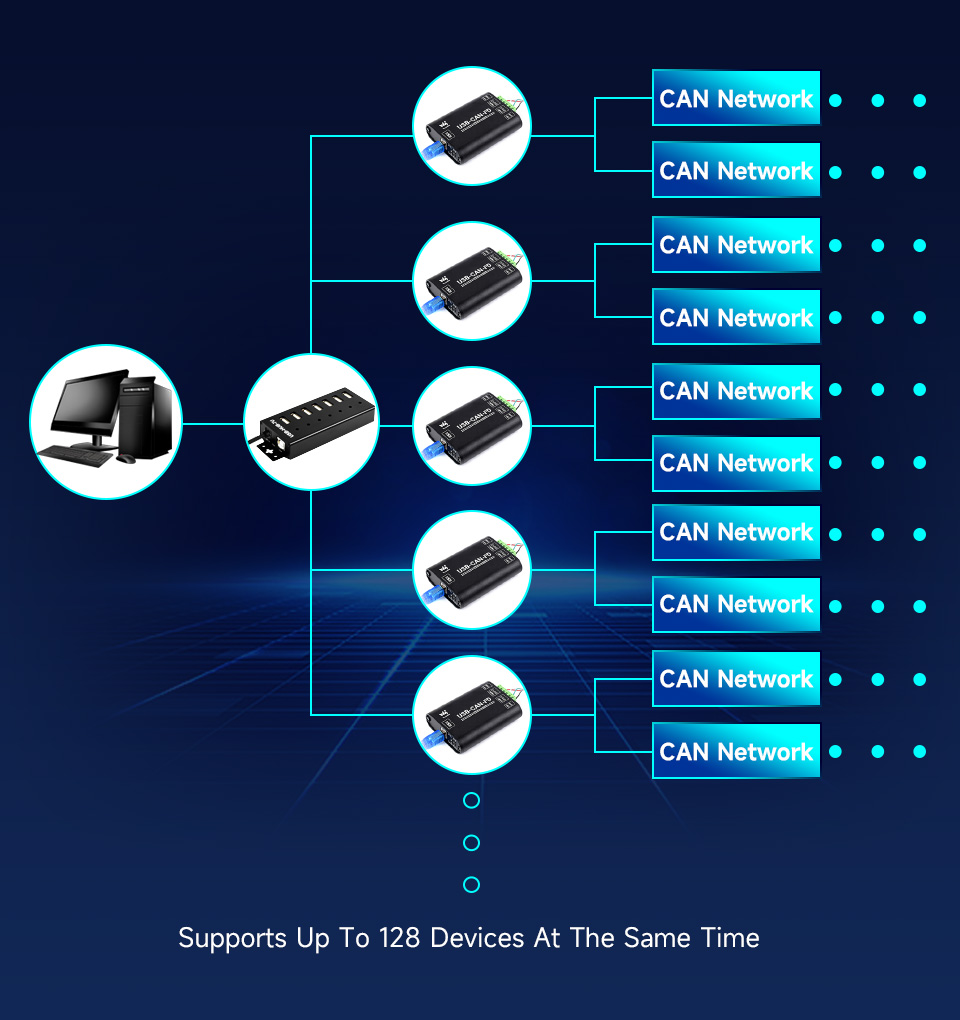
One PC With Multiple Devices
Supports one PC to run multiple CAN FD analyzers at the same time without interfering with each other, up to 128 devices after testing. It is suitable for monitoring multiple CAN networks at the same time with one monitoring device, or for data comparison and verification and so on.
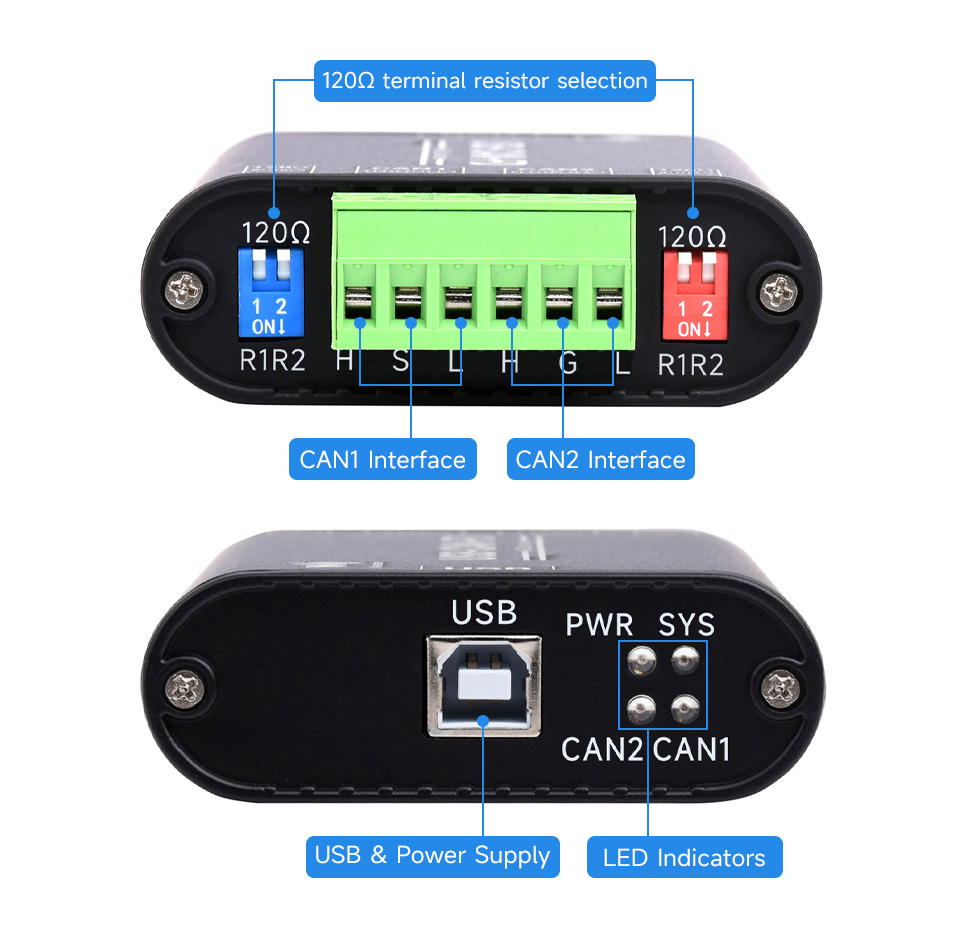
Interface introduction
Application Scenarios
Application Example
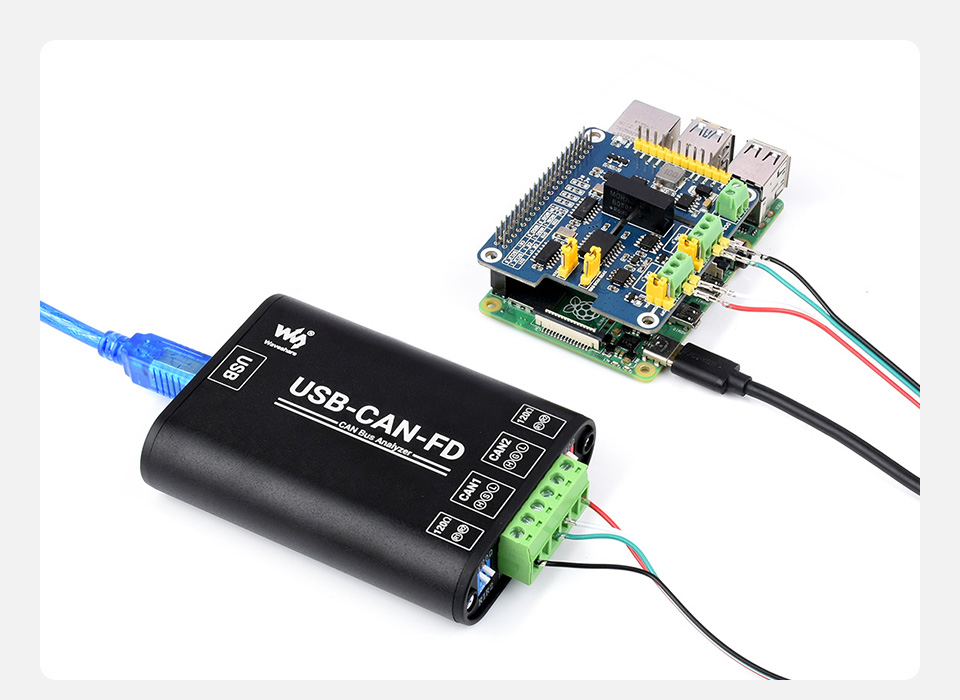
* for reference only, the Raspberry Pi 4B and 2-CH CAN FD HAT are Not included.
Product show
Outline dimensions
Resources & Services

| t | Model | USB-CAN-FD | USB-CAN-FD-B |
|---|---|---|---|
| Picture |
|
|
|
| Type | Industrial grade: USB to CAN FD interface converter, CAN/CAN FD bus communication interface card, CAN/CAN FD protocol data analyzer | ||
| USB | Operating voltage | 5V (directly powered by USB port without external power supply) | |
| Connector | USB-B | ||
| CAN/CAN FD interface | CAN/CAN FD channel | Dual-channel: CAN1 and CAN2 (independent and full-isolated, isolated voltage: 3000V DC) | |
| Connector | CAN bus screw terminal (OPEN6 5.08mm pitch) | ||
| Terminal resistor | Each CAN/CAN FD channel has two built-in 120Ω terminal resistors, which can be enabled by switch | ||
| Baud Rate | 100Kbps~5Mbps (Configurable via software) | ||
| Protocol Support | CAN2.0A, CAN2.0B, and ISO 11898-1 CAN FD protocol V.1.0 | ||
| Transfer speed | The receiving and sending speed of each CAN/CAN FD channel can reach 20000 frames/s and 5000 frames/s | ||
| Transmit buffer | 1500 frames receiving buffer and 64 frames sending buffer per channel (automatically retransmit when the transmission fails) | ||
| Indicators | PWR | Power indicator | |
| SYS | System status indicator, normally off; keeps on when there is a bus error | ||
| CAN1 | CAN1 channel indicator (blinking when sending and receiving data) | ||
| CAN2 | CAN2 channel indicator (blinking when sending and receiving data) | ||
| System support | Windows | Windows XP/7/8/10/11 (32/64 bits) | |
| Linux | Not support | Raspberry Pi OS (for Raspberry Pi), Ubuntu (for Jetson Nano), Linux system on VMware virtual machines, etc. |
|
| Operating temperature | -40~85℃ | ||
| Case material | Aluminum alloy case + 3D flame-retardant insulating sheets on both sides (This design can provide better protection against metal tip discharge, also improves product safety, and extends service life) | ||
| Dimensions | 104 × 70 × 25 mm | ||
Device connection:
Plug the converter into a computer’s USB port. The device is powered directly by the USB port (5 V).
CAN network connection:
Use the 5.08 mm terminal block on the device to connect CAN H and CAN L to the target CAN or CAN FD network.
Software configuration:
Install the provided control software or use the supplied API to configure baud rate, operating mode, and data frame format.
Termination resistor enable/disable:
Each CAN channel integrates a 120 Ω termination resistor. Enable or disable it using the small onboard switch according to the network topology.
Dual-channel operation:
CAN1 and CAN2 can operate independently, allowing simultaneous monitoring or parallel communication between two separate systems.
Device storage:
When not in use, disconnect the device from the computer and store it in a dry place. Avoid moisture and strong mechanical impacts.
Cleaning:
Wipe gently with a dry cloth. Do not use chemical solvents that may damage the aluminum enclosure.
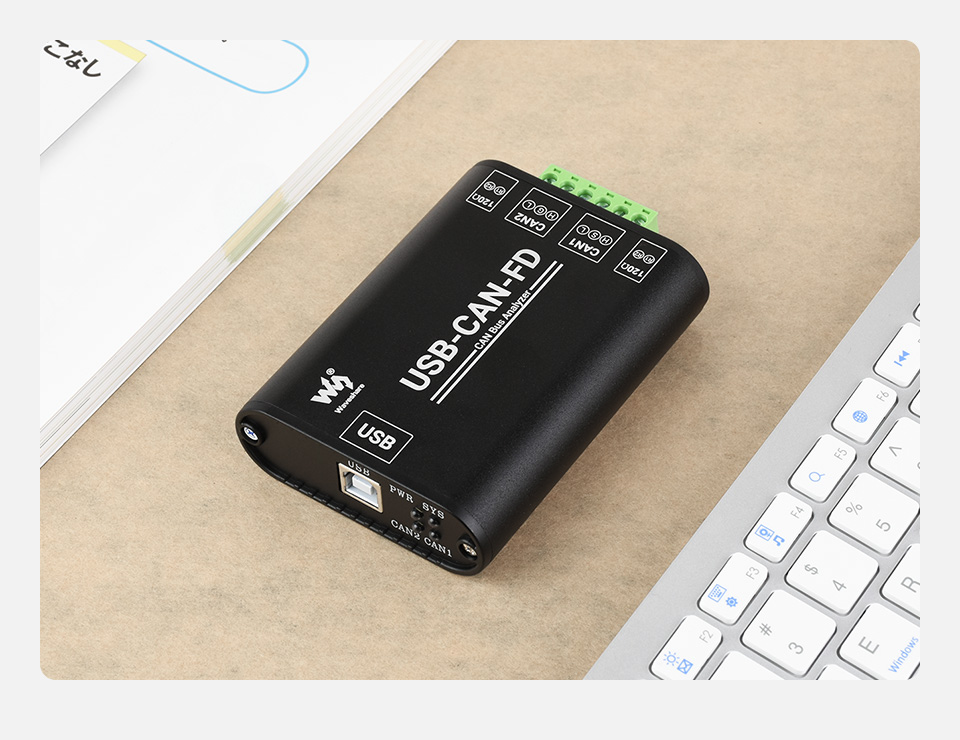
USB port:
Used to connect to the computer and supply power to the entire circuit.
Status indicators:
LED indicators display power status, operating status, and data transmission activity for each channel.
CAN1 and CAN2 ports:
6-pin terminal blocks used to connect to the corresponding CAN/CAN FD bus.
120 Ω termination switch:
Used to enable or disable the termination resistor for each channel to match the specific CAN network configuration.
Protective aluminum enclosure:
Provides EMI protection, effective heat dissipation, and mechanical safety for industrial environments.
We will contact and send a quote based on the information you provide!






.webp)